

Organization size:
1,000-9,999 employees
Partner name
GET AI
Partner type
SI
Industries
Professional Services
Business function
Operations
Graebel uses governed automation to modernize global relocation service orders with Microsoft Copilot Studio
Graebel is a global leader in talent movement, delivering end-to-end workforce mobility and managed services for multinational organizations. Each year, Graebel manages thousands of domestic and international employee moves. This work requires precision, strong compliance, and a smooth experience for both client and employees.
To support growing global demand and maintain operational excellence, Graebel is using AI agents to modernize how service order requests move from unstructured email into its proprietary Graebel globalCONNECT® platform.
Using Microsoft Copilot Studio, Azure AI services including Azure AI Content Understanding, and computer use capabilities, Graebel built an AI-powered workflow that can interpret service order requests, apply business logic, and complete actions inside globalCONNECT. This reduces manual work and allows teams to spend more time supporting clients and employees.
By adopting Microsoft Copilot Studio and AI agents, we moved beyond traditional automation to a more intelligent, scalable operating model. This helps us serve clients faster and more accurately, while allowing our teams to focus on high-value support and long-term growth.
— Matt Brownlee, Chief Operating Officer, Graebel
Modernizing relocation service orders with the Graebel Service Order Agent
A significant share of Graebel’s relocation service requests arrives through email from clients and partners. These emails often include employee details, service scope, timelines, and compliance requirements. Operations teams must review this information and manually enter it into globalCONNECT.
As relocation volumes increased, this process became harder to manage. Manual review and data entry increased effort and cost. Different email formats made errors more likely. During busy periods, turnaround times slowed for both clients and internal stakeholders—introducing friction at critical moments in the employee relocation process. Because globalCONNECT doesn’t expose APIs for this workflow, Graebel needed a solution that could understand unstructured content, apply business logic, and work inside the platform experience already used by trained operators.
Graebel introduced the Service Order Agent to remove friction at the source and support operations teams. It converts qualifying service order emails into accurate, compliant transactions in globalCONNECT while preserving governance and human oversight.
A simple, governed AI workflow
Built with Microsoft Copilot Studio and Azure AI, the Graebel Service Order Agent combines content understanding, business-rule validation, orchestration, and user-interface interaction into a governed automation flow. The agent monitors designated service order email channels, uses Azure AI Content Understanding to interpret unstructured instructions and extract key data fields into a structured format. It then applies service logic and compliance checks, and then uses computer use capabilities to navigate globalCONNECT through its user interface.
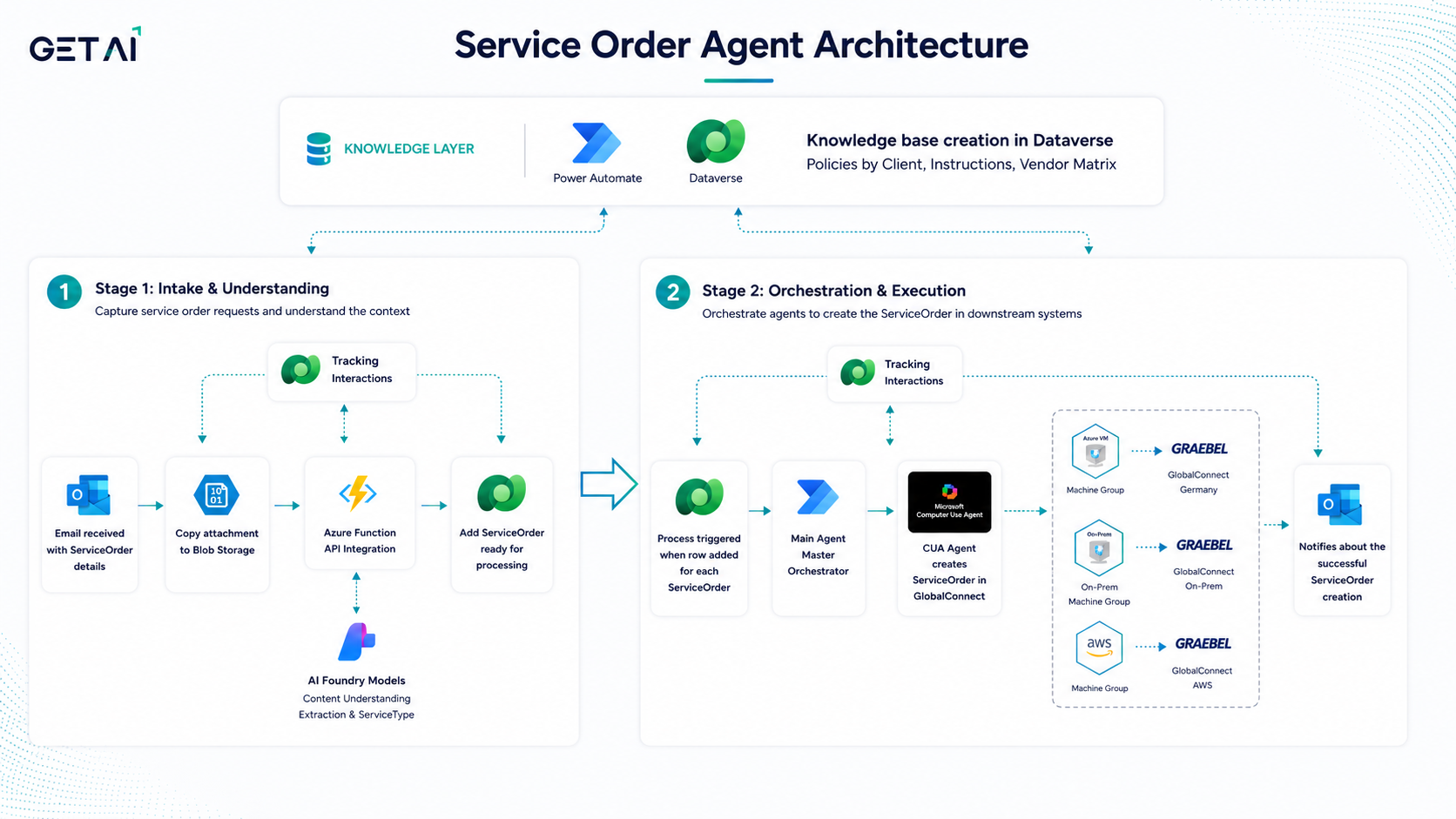
The agent completes transactions the same way a trained operator would, while routing low-confidence cases, exceptions, and approvals for human review. This lets Graebel modernize a mission-critical workflow without changing the underlying platform. It also reduces the maintenance burden associated with brittle, script-based automation.
- Operations teams can shift qualifying, high-volume service order entry to the agent and focus on exceptions and high-touch client interactions.
- Compliance and governance stakeholders retain control through human-in-the-loop review for low-confidence cases, approvals, and exceptions.
- Service delivery leaders gain a reusable automation foundation that can scale across more than 30 relocation service categories over time.
Delivering clear business value
Graebel delivered the Service Order Agent in partnership with GET AI and Microsoft. Microsoft Copilot Studio provides the low-code agent authoring and orchestration layer, while Azure AI services support interpretation of unstructured content and structured extraction of service order details. By working directly with the globalCONNECT user interface, the agent helps operations teams increase capacity while preserving the systems, controls, and compliance practices that support global mobility service delivery.
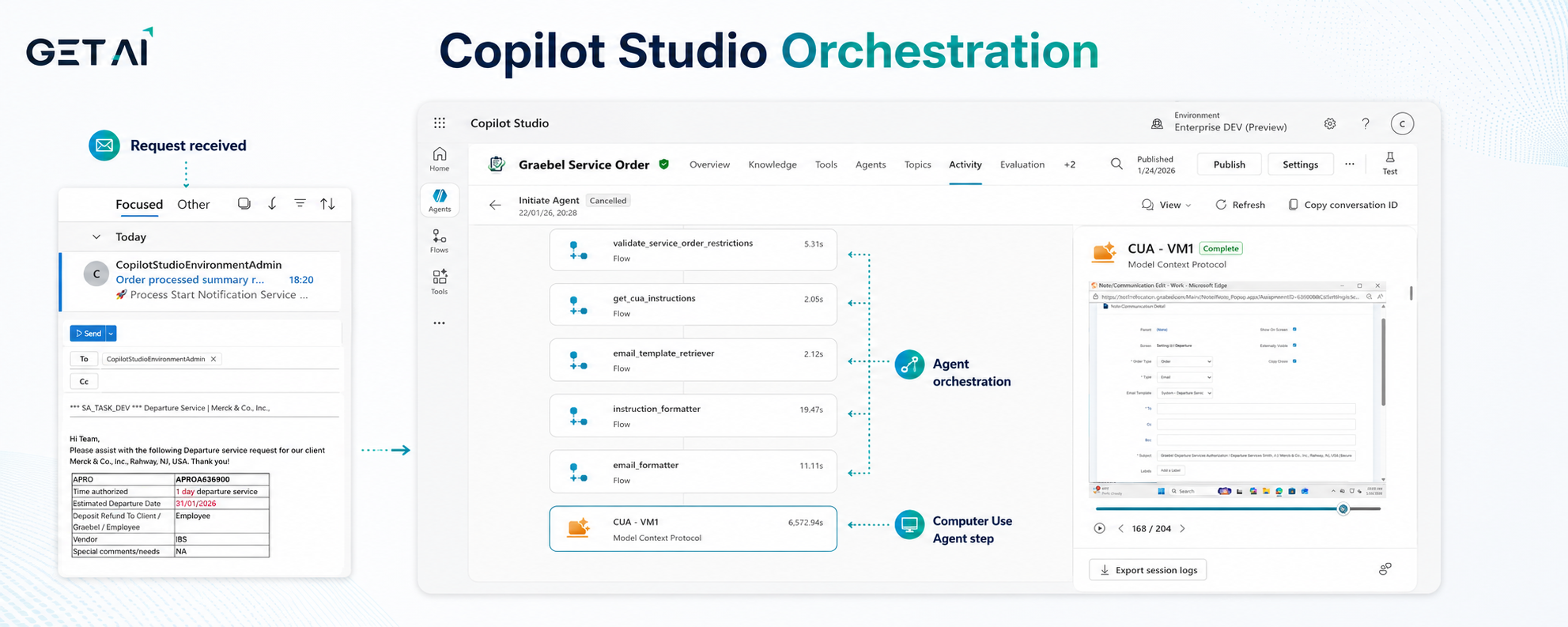
The pilot focuses on a small set of high-volume service order types, with an architecture designed to extend the same workflow model to additional relocation services over time. Early results show less manual effort, faster turnaround times, improved consistency through AI-driven extraction and validation, and a repeatable approach that Graebel can use for other operational processes.
Advancing enterprise AI at scale
Together, Graebel, GET AI, and Microsoft have shown how AI agents can support complex enterprise workflows—especially where legacy platforms, unstructured inputs, and compliance requirements make traditional automation difficult. For Graebel, the Service Order Agent is a model that can extend across global mobility operations. It improves responsiveness and frees teams to focus on more personal support for clients and employees.
By combining Microsoft Copilot Studio, Azure AI, and computer use capabilities with Graebel’s industry expertise, the company is embedding AI directly into everyday operations. It turns unstructured email requests into governed, compliant transactions in globalCONNECT and raises the bar for AI-powered service delivery. This approach combines intelligent automation with human expertise to elevate the relocation experience.